
The Ultimate Guide to Multifunctioning Machining
Comments Off on The Ultimate Guide to Multifunctioning MachiningWhen a component requires turning, milling, drilling, threading, tapping, and other operations, moving it between multiple machines can add setup time, increase handling, and create opportunities for error. Multifunctional machining combines multiple machining processes within a single CNC machine, helping manufacturers produce complex components more efficiently while maintaining precision and consistency.
Advanced Industries, Inc. makes multifunctioning machining a core part of its precision manufacturing capabilities. With advanced CNC equipment capable of performing turning and milling operations in the same setup, the company can reduce the need to transfer parts between machines. Features such as twin-spindle technology, live tooling, Y-axis functionality, and up to nine-axis machining allow Advanced Industries to manufacture complex components with fewer interruptions and greater consistency.
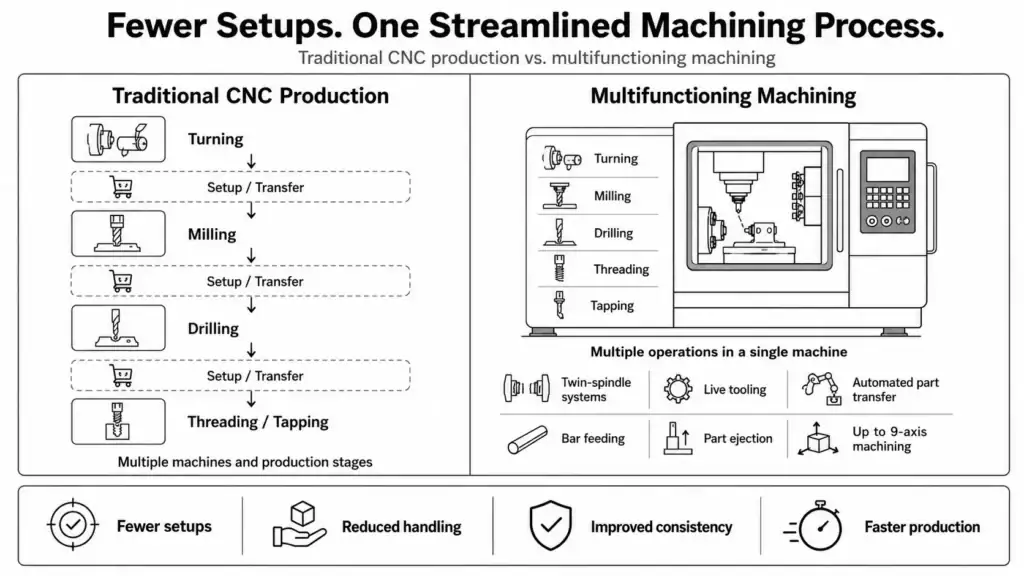
Breaking Down the Multifunctioning Process
Traditional CNC production may require a workpiece to move between multiple machines as different operations are completed. Each transfer introduces another setup, additional handling, and the potential for dimensional variation. Multifunctional machining consolidates many of these operations into a streamlined process, reducing the need for repeated setups.
Advanced Industries uses multifunction CNC equipment designed to perform multiple operations within a single machining cycle. Depending on the machine configuration, twin-spindle systems allow components to be machined from multiple sides, while live tooling enables milling, drilling, and other secondary operations directly on the turning machine. Y-axis capability adds flexibility for machining off-center features, slots, flats, and complex geometries.
Additional automation, including bar feeding, synchronized spindle operations, and automatic part ejection, can further streamline production and reduce manual handling.
This approach is particularly beneficial for components that combine cylindrical and milled features. Mill-turn machining can produce parts requiring turned diameters, flats, cross-holes, contours, threads, and other detailed features without requiring separate machining setups for every operation.
By consolidating these processes, manufacturers can simplify production workflows, improve coordination between machining operations, and reduce the handling associated with conventional manufacturing methods.
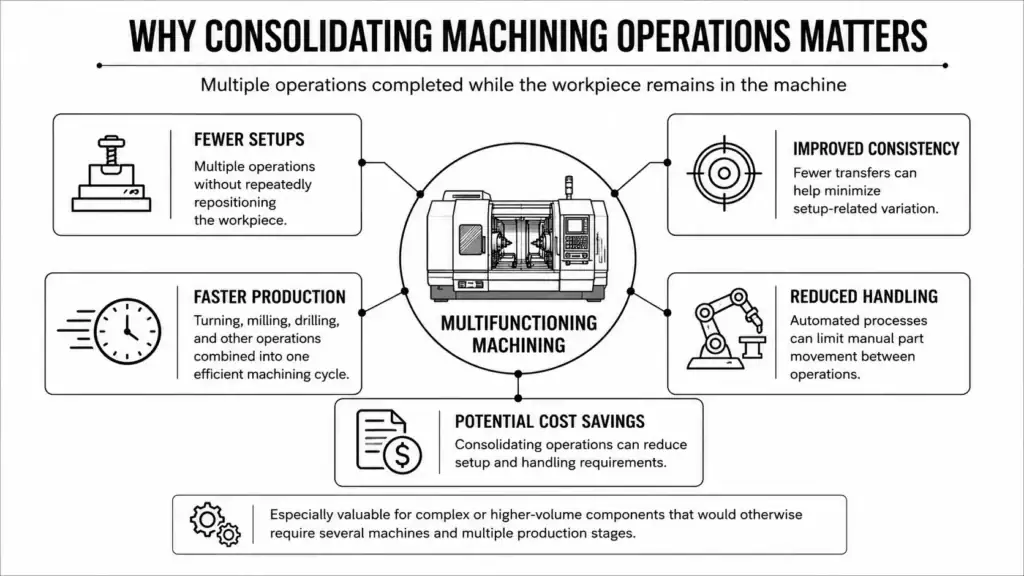
Speed and Quality: The Dual Benefits
The value of multifunctional machining extends beyond performing more operations on a single machine. By reducing the number of setups and transfers, manufacturers can improve production efficiency while maintaining tighter control over dimensional accuracy.
When a workpiece remains securely positioned during multiple machining operations, there are fewer opportunities for repositioning errors and setup-related variation. Advanced Industries combines multi-axis machining, live tooling, automated features, and high-performance CNC equipment to help reduce cycle times while meeting the dimensional requirements of demanding applications.
Key benefits include:
- Fewer setups: Multiple machining operations can be completed without repeatedly repositioning the workpiece.
- Improved consistency: Fewer transfers can reduce setup-related variation and help maintain dimensional accuracy.
- Faster production: Turning, milling, drilling, and other operations can be combined into an optimized machining cycle.
- Reduced handling: Automated processes can limit manual movement between operations and reduce work-in-process requirements.
- Potential cost savings: Consolidating operations can reduce setup labor, handling, and the need for multiple dedicated machines.
For complex or higher-volume components, these efficiencies can make a substantial difference in manufacturing productivity. Mill-turn machining services are especially valuable when a component would otherwise require multiple machines, repeated setups, and several production stages.
The Role of Multi-Axis and Twin-Spindle Technology
Modern multifunctional machining centers combine several capabilities to expand the range of components that can be produced efficiently.
Twin-spindle machines feature two workholding spindles, typically a main spindle and a sub-spindle, allowing a component to be machined from different ends or transferred automatically for secondary operations. This can reduce the need for a separate operation to finish the opposite end of a part.
Live tooling adds a separate milling spindle or driven-tool capability, depending on the machine design, allowing cutting tools to rotate while producing features on the workpiece. Combined with Y-axis movement and rotary-axis capability, these systems can machine increasingly complex geometries within a single setup.
Axis count describes the number of independently controlled motion axes, not the number of physical spindles. A nine-axis machine, for example, does not necessarily have nine spindles. Instead, its coordinated linear and rotary movements provide greater flexibility in positioning tools and workpieces.
Together, these technologies enable manufacturers to consolidate operations, reduce unnecessary part transfers, and produce complex components with greater efficiency.
Choosing the Right Multifunctional Machining Partner
Successful multifunctional machining depends on more than advanced equipment. It also requires careful process planning, appropriate tooling, effective programming, and a thorough understanding of component requirements.
Advanced Industries, Inc. combines precision CNC machining capabilities with multifunctional manufacturing processes to help customers produce complex components efficiently and consistently.
By evaluating part geometry, material requirements, tolerances, and production volumes, manufacturers can determine where mill-turn and multi-axis machining offer the greatest advantages.
For components that require multiple machining operations, multifunctional machining provides a practical way to simplify production, improve repeatability, and support demanding quality requirements while reducing unnecessary handling and setup time.
Industries That Benefit Most
Multifunctioning machining is well suited for industries that depend on complex, precise components and consistent production. Advanced Industries serves customers in aerospace, military and defense, automotive and transportation, medical, optics, electronics, energy, hydraulics, robotics, automation, machine tools, marine, and other demanding industries.
The technology is particularly useful when components feature both turned and milled surfaces or require several machining operations to be completed accurately. It can support both prototype and production requirements, giving customers a flexible manufacturing solution as projects progress from initial designs to repeat production.
Advanced Industries has provided precision CNC machining since 1991 and combines its machining capabilities with extensive secondary services and quality-control processes.
Request a Project Evaluation
Every component has different requirements. Material, geometry, tolerances, quantities, and production schedules all influence the best machining approach. Advanced Industries can evaluate your project and determine whether multifunctioning machining can simplify production and improve efficiency.
For components requiring combined turning and milling operations, Mil-turn machining services may offer an effective alternative to moving parts between multiple machines. Advanced Industries can support projects from prototypes through production with precision CNC turning, milling, Swiss machining, inspection, finishing, and other manufacturing services.
With AS9100D and ISO 9001:2015 certifications, Advanced Industries is equipped to support demanding applications where quality and consistency matter.
Have a complex component that needs a more efficient manufacturing process? Request a project evaluation from Advanced Industries, Inc. and see how multifunctional CNC machining can work for your application.
